“The names that we give to the places in the landscape, no matter whether it relates to their physical shape, their colour, their functional use, or their historical and spiritual legacy, are the foundations of our awareness of who we are and how we come to be precisely here, in this named place.”
Last night I read Frank Rennie’s new book Among the Layers of the Land which he will be discussing at the upcoming St Andrew’s Book Festival in London (25 Nov – 1 Dec www.standrewsbookfestival.org). Combining scholarly analysis of our connection to place and the different knowledge bases we use to understand it with short fictional stories this work encourages us to think more deeply about how we connect with the world around us. A story about how the local gillie tricked a millionaire visitor to crawl around collecting rabbit poo is a memorable final story!

This book was particularly interesting for me as my Masters’ dissertation (over 10 years ago now – wow) looked at place-making and community engagement in the local museum sector. My dissertation focused on built heritage, objects, place-names and intangible heritage and Frank’s book also draws out how important naming of places and human uses and changes to the land are in our understanding of the landscape. Our view of landscape can also change over time. Maps are used as an example on point – maps, like all historical documents, contain their own bias; the features that the cartographer chooses to include can be dictated by personal, political or academic motives.
The book keys into many themes – geology, geography, etymology, cultural heritage, environmental studies – and I’m sure Frank’s joint event with James Crawford, author of Wild History – Journeys into Lost Scotland will be very interesting and evocative, whether you are very familiar with or relatively new like me to Scotland’s rich landscapes. I enjoyed learning about the rich nuances of the Gaelic language in describing the landscape: colour descriptions in Gaelic are much more nuanced than Standard English – many of the place names are graphically descriptive of the shape of the landform, or the colouration produced by natural vegetation or by the underlying geology. Chromatic colour in Galiec is heavily dependent on the landscape setting rather than simply the frequency of absorbed light. There are also special Gaelic words highlighting our connection to place: cianalas – loosely meaning homesickness but which can be much more intense, and buntanas – the concept of belonging, of rootedness.
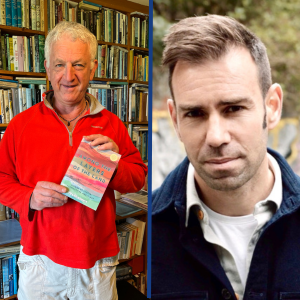
Frank Rennie and James Crawford
Frank lives with his family in the crofting village of South Galson in the Isle of Lewis, a community-owned estate. He is Professor of Sustainable Rural Development at the University of the Highlands and Islands and a Research Associate of the UHI Environmental Research Institute. A natural scientist by training and inclination, he has also been closely involved in the community and cultural development of this region for forty years.
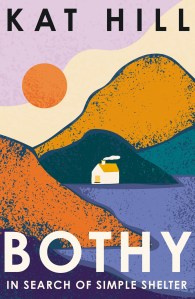
I’m also in the process of reading Kat Hill’s Bothy – In Search of Shelter which also explores our connection to place, environmental management and the written archives of bothy visitors. Kat’s event follows on from Frank and James’ on Thursday 28 November, guaranteeing a very interesting evening.
Event Details for Frank Rennie and James Crawford
Thursday 28 November
7:15pm
St Columba’s Church, LONDON SW1X 0BD
More event details and tickets at: https://tinyurl.com/5xvskxk9
 Jennifer Rowland